Dollar-cost averaging means investing the same amount at regular intervals, for example KES 5,000 every month, whatever the price is. When prices are low you buy more units. When they are high you buy fewer.
A worked example
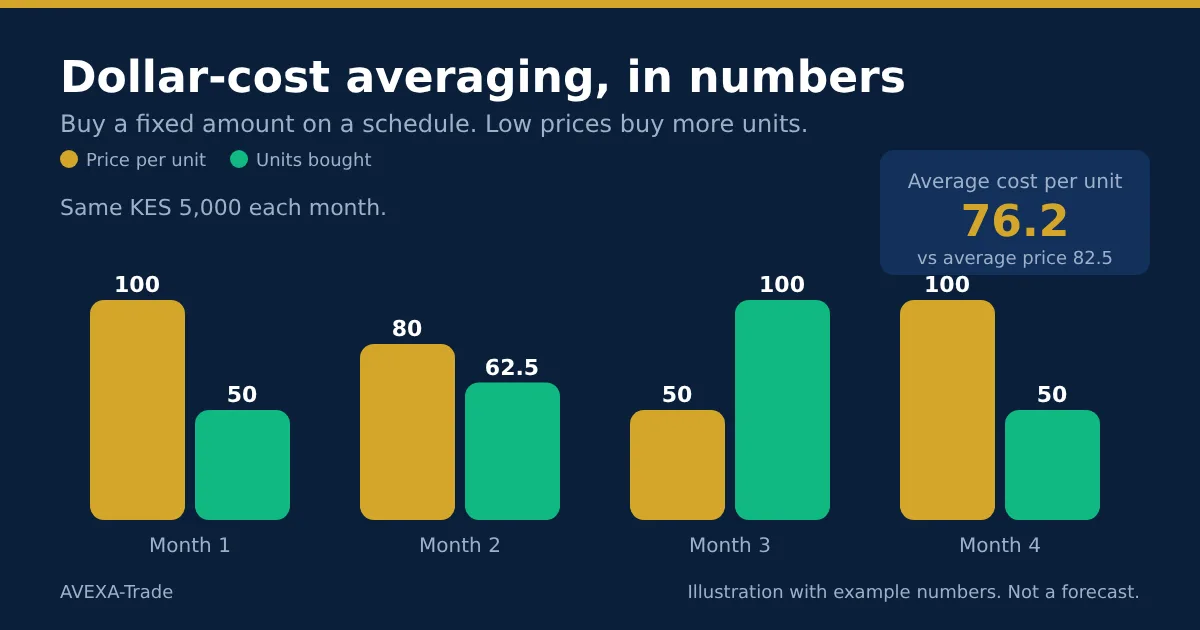
Suppose you invest 5,000 shillings each month in an asset over four months and the price per unit is 100, 80, 50 and 100.
| Month | Amount | Price per unit | Units bought |
|---|---|---|---|
| 1 | 5,000 | 100 | 50 |
| 2 | 5,000 | 80 | 62.5 |
| 3 | 5,000 | 50 | 100 |
| 4 | 5,000 | 100 | 50 |
You spent 20,000 and bought 262.5 units, an average cost of about 76.2 per unit. The average market price over the four months was 82.5. Buying a fixed amount gave you a lower average cost than the average price. This is the idea behind DCA. It is an illustration with made-up numbers, not a forecast.
What DCA does well
- It removes the pressure of picking the perfect day.
- It builds a habit, which suits people who are paid monthly.
- It reduces the damage of one badly timed large purchase.
What DCA does not do
- It does not guarantee a profit. If the asset keeps falling, you keep buying a falling asset.
- It does not remove risk. It spreads the timing risk only.
- Fees add up. Many small purchases with a fixed fee each can cost more. Check the fee per trade.
How to set up a plan
- Pick an amount you can keep paying without touching your emergency fund.
- Pick a schedule, such as weekly or monthly.
- Choose assets you understand, and do not put everything in one.
- Review every few months, not every day.
Our DCA bot can run the schedule for you after you create an account.
Keep reading
Buy crypto with M-PesaStart investing in KenyaStocks vs crypto